
Paper Overview
An Activity Theory Analysis of Search & Rescue Collective Sensemaking and Planning Practices
The gap between practice and academia is even wider when considering technology academia and EM practice. Software that doesn’t meet basic needs, doesn’t really do what is needed for practice, and is not customizable by practitioners. Much of this is the result of technology academia, private enterprise, or software developers in general having insufficient access to the environment they are creating for. Alternatively (and perhaps more likely) designers have not done their due dilligence to learn how to best design for the space they are designing for. Articles like this one are an attempt to understand the basic patterns of practice in EM, in this case, Search and Rescue operations. And aspect of my work that I have been trying to pursue relentlessly is that I believe that much of science and technology integration inside of emergency management really wants to happen but that there are no translators between two exceedingly different sides.
For this paper, we sought to contribute the following:
SAR is a socio-technical system that bridges physical, digital, and geographic spaces. As a socio-technical system, SAR is unique for HCI spaces in that it is not only currently “low-tech” but tech-avoiding due to technology’s fragility. By bringing SAR to HCI, we provide a rich area for research and design focusing on practical deployment that concurrently increases the resiliency of information communication technology. The present research extends prior work in disaster response practice and training and encourage future research in this area.
In otherwords, we were seeking to deal with a problem within technical spaces in that if you are “low tech” you are a dinosaur and will eventually go extinct. This mode of thinking is highly prevalent inside of the tech industries, private, public, and academic. While there are reasons for this mostly relating to what we would call “modernization,” the truth of the matter is that the future is not felt symmetrically.
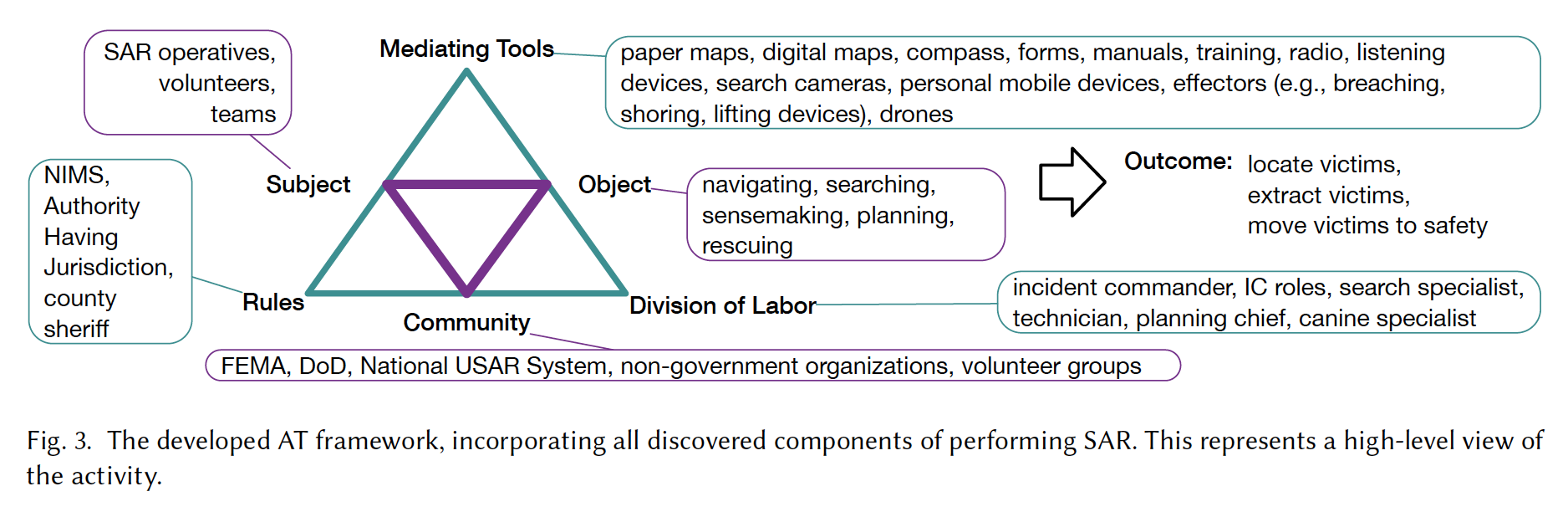
What this piece allows us to do is to describe the operating environment of SAR teams by describing SAR as an activity with a goal, tools, rules, communities, and a division of labor. Within what we’re doing, we used Activity Theory to do this.
Activity Theory is a way for us to see outside of a person using a computer or a SAR team member walking around trying to find survivors. Instead, it allows us to incorporate all aspects of the activity in general. And in doing so, we can point to potential areas of tension where technology could relieve (or excacerbate) it.
To perform the study that produced this paper, the primary researcher, in this case Dr. Sultan Alharthi, began by taking SAR courses online. He followed this up by visiting disaster city, interviewing SAR team members, administering a survey to SAR online, and evaluating document or artifacts like tests, videos, and textbooks.
After evaluating all of these things, we conclude by discussing how, “One of our most powerful discoveries is that while SAR does not incorporate many information communication technologies, the use of maps is an important source of information in the practice of SAR that can be digitized in an effort to widen the number of eyes participating in the act of search and rescue.”
But we additionally note that in order to do this, we need to design for the asymmetrical work of SAR. Different levels of command within ICS must be able to pull/push/show different types of data and everyone must work from the same operating picture. And more than anything, this tool must be ready to be used with just as much efficacy as a paper map.
To some, this is a common sense observation; however, it is important to note that because of the way that domains like human-computer interaction, computer science, and user-experience design see the world, the most common sense approach is that paper maps are not software and so you cannot design for them as they do not have the literacy to understand. By presenting this piece the way that we have, we show that it is not the user, but engineers and designers who need to change their mindset. And this is what integration is all about, getting people on the same page.
Other Post Formats
CRISIS INFORMATICS · PAPER REVIEW
social media crisis informatics needles in haystacks